What is a dental air polisher?
A dental air polisher is a professional device used in dental hygiene and prophylaxis to remove biofilm, soft deposits and extrinsic stains from tooth surfaces. It works by directing a controlled jet of compressed air, water and a fine cleaning powder onto the tooth and surrounding tissues. The combined spray cleans surfaces that are difficult to reach with hand instruments alone — including pits, fissures, interproximal areas and surfaces around brackets, implants and prosthetic restorations.
Air polishers are used by dentists, dental hygienists and prophylaxis assistants in private practice, group practices and dental service organizations. Depending on the powder and nozzle, the same family of devices can be used supragingivally (above the gum line, mostly for stain and biofilm removal) or subgingivally (below the gum line, in periodontal and peri-implant maintenance).
How dental air polishing works
The basic principle is consistent across brands: the unit pressurizes air, mixes it with a measured stream of water and entrains a fine powder. The resulting jet hits the tooth surface in a tightly controlled way. The powder particles do the cleaning work; the water cools and rinses; the air carries everything to the working tip.
What differs between systems is mostly:
- How the unit is integrated — standalone cart, tabletop unit, handpiece on an existing dental coupling, or single-handpiece combined modality.
- Which powders are validated — sodium bicarbonate, glycine, erythritol, calcium carbonate or proprietary blends.
- Whether the unit also delivers ultrasonic scaling in the same workflow.
- Whether subgingival use is supported, and with which dedicated nozzle.
- Ergonomics — handpiece weight, tubing, foot control and chair-side footprint.
How big is the dental air polisher market?
The global dental air-polishing systems market is sized at USD 900.49 million in 2025 and is projected to reach USD 953.98 million in 2026, growing to USD 1,603.54 million by 2035 at a CAGR of 5.94 % (2026–2035) according to Precedence Research. This is a sign of category maturity: the segment is large enough to support stable competition between major manufacturers, and it is growing fast enough to justify clinic investment in new equipment generations.
Key structural facts about the segment:
- Tabletop air-polishing units account for roughly 60 % of the segment — the dominant product class. Standalone polishers and handpiece-only systems make up the rest.
- Dental clinics generate ~63 % of segment revenue. Dental service organizations (DSOs) and hospitals account for the remainder.
- Asia-Pacific is the fastest-growing region, with a CAGR around 6.5 %. North America and Europe remain the largest revenue bases.
Sources: Precedence Research, Dental Air Polishing System Market Size to Hit USD 1603.54 Million by 2035. Market-research figures are forecasts and should be re-verified annually.
The 6 player-tier brands and systems
Six brands are consistently flagged as primary prophylaxis players across public market reports, distributor catalogues, and trade-show floor presence. Listed alphabetically:
- Acteon (France) — Air-N-Go family of air polishing units, with multiple powder options for supragingival and subgingival use. OPUS combined tabletop platform. Acteon Air-N-Go overview →
- Dentsply Sirona (USA) — Owns the Cavitron product family. The Cavitron Prophy Jet is the air polisher that fits alongside Cavitron Plus magnetostrictive ultrasonic scalers — common in practices already invested in the Cavitron ecosystem. Cavitron Prophy-Jet overview →
- EMS (Switzerland) — Current flagship combined tabletop is the GBT Machine (IDS 2025 launch). The predecessor AIRFLOW Prophylaxis Master remains actively sold in select markets — confirm with your local distributor. Both run the same 8-step Guided Biofilm Therapy protocol with AIRFLOW (supragingival), Perioflow (subgingival) and Piezon (ultrasonic). The AIRFLOW Handy 3.0 Plus is the documented EMS handpiece that accepts erythritol PLUS Powder (subgingival ≤4 mm) — an exception to the general "handpieces default to bicarbonate or glycine" rule. EMS GBT Machine → · AIRFLOW Prophylaxis Master →
- Hu-Friedy (USA) — Re-entered the powered prophylaxis category at Chicago Midwinter 2026. PWR Air is a tabletop air polisher (air polishing only). PWR Pair combines air polishing and ultrasonic scaling in a single handpiece with PWR Feedback haptics — architecturally different from the EMS/NSK/Mectron tabletop-plus-multiple-handpieces approach. Hu-Friedy PWR Air & PWR Pair →
- NSK (Japan) — Three relevant products: Varios Combi Pro2 (combined tabletop), Prophy-Mate neo (supragingival handpiece, uses NSK Flash Pearl — a branded calcium carbonate powder, ~54 μm — or glycine; not erythritol), and Perio-Mate (subgingival counterpart with dedicated nozzle). NSK Prophy-Mate neo → · NSK Varios Combi Pro2 →
- Woodpecker (China) — Cost-competitive standalone polishers (AP-H) and combined ultrasonic + air polishing units (PT-E). Compatible with sodium bicarbonate and glycine; not erythritol on the EU market. Broad international availability. Woodpecker air polisher →
Adjacent-tier brands worth knowing
Two more brands appear regularly in prophylaxis comparisons, with strong reputations in adjacent dental categories (ultrasonic scaling, periodontology, restorative) and narrower air-polishing footprints:
- Mectron (Italy) — Combi Touch combined tabletop unit (ultrasonic + air polishing with dedicated subgingival nozzle). Strong piezo ultrasonic platform (Multipiezo) heritage. Mectron Combi Touch →
- W&H (Austria) — Proxeo Aura air-polishing handpiece with adjustable powder ring and multiple coupling options. SOFT and SMOOTH (sodium bicarbonate) and SENSITIVE (glycine) branded powders. Ex-VAT EU reference €400–€600 (April 2026). W&H Proxeo Aura →
See our detailed brand-by-brand comparison →
Dental air polisher price range
Pricing varies widely by country, distributor and configuration. As a general orientation:
- Compact handpiece-style polishers (NSK Prophy-Mate neo, W&H Proxeo Aura, EMS AIRFLOW Handy 3.0 family) typically sit at the lower end of the range. Reference ex-VAT EU on the Proxeo Aura is €400–€600 (April 2026).
- Combined ultrasonic + air polishing units (Mectron Combi Touch, NSK Varios Combi Pro2, Woodpecker PT-E) sit in the mid-range.
- The Hu-Friedy PWR Pair combined single-handpiece sits around €1,800–€2,200 ex-VAT EU (April 2026).
- Premium integrated workflow systems such as the EMS AIRFLOW Prophylaxis Master and the current EMS GBT Machine are positioned at the top of the range.
Total cost of ownership also depends on training, consumables, service contracts and replacement parts. We strongly recommend comparing at least two suppliers and asking for an itemized quote before deciding.
See more on EMS AIRFLOW Prophylaxis Master pricing →
What to check before buying
Most clinics that have gone through a buying decision recommend reviewing the following points:
- Clinical indication — Is the device intended only for supragingival use, or also for subgingival biofilm management around teeth and implants?
- Validated powders — Which powders does the manufacturer support, and are they easy to source in your country?
- Local distributor — Coverage in your region, response time and availability of loaner units during service.
- Training — Whether structured onboarding or certification (e.g. GBT for EMS, MIT for NSK, ABC for Woodpecker) is part of the deal.
- Workflow — How the unit fits into your existing hygiene appointment, sterilization and instrument setup.
- Total cost of ownership — Capital cost, consumables, parts, service contract and any leasing/financing options.
Air polishing powders and consumables
The cleaning powder is as important as the device itself. The most common categories are:
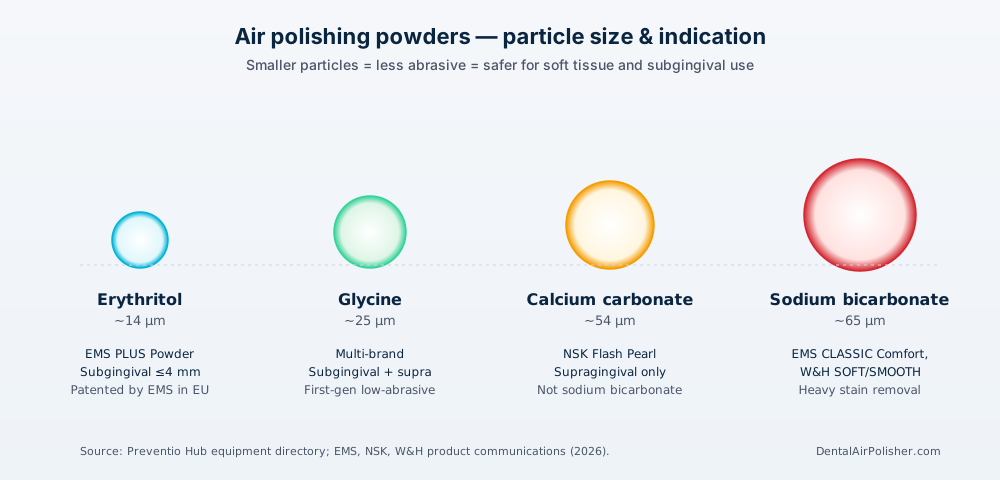
- Sodium bicarbonate — The traditional powder, indicated for supragingival use on enamel and stain removal. Used by most brands (EMS CLASSIC, W&H SOFT/SMOOTH, Hu-Friedy, Woodpecker, Cavitron Prophy Jet).
- Glycine — A lower-abrasion powder validated for supragingival and certain subgingival applications. Universal across brands.
- Erythritol — A very fine, low-abrasion powder used for biofilm management, including subgingival use. EMS holds the European patent — on the EU market, erythritol air-polishing powder is available only with EMS devices (and on the documented EMS handpiece exception, the AIRFLOW Handy 3.0 Plus).
- Calcium carbonate — Used in some systems for stain removal with reduced abrasiveness on enamel. The branded example is NSK Flash Pearl (calcium carbonate, ~54 μm).
Each manufacturer typically validates specific powders for specific units and clinical indications. Using non-validated powders can void warranty and damage internal components. Always confirm with the manufacturer or distributor.
Demo, training and support
For most professional air polishers, the buying experience involves more than just receiving a unit:
- Demo — Many distributors offer a chair-side demonstration so the team can try the device on patients before purchase.
- Training — Some systems include structured training and certification (Guided Biofilm Therapy for EMS, M.I.T. for NSK, ABC Protocol for Woodpecker).
- Service — Annual maintenance, software updates and warranty terms vary significantly between manufacturers.
If your clinic plans to invest in air polishing as part of a structured prophylaxis offering, the depth of training and support is often more important than the headline price. Compare GBT vs MIT vs ABC →