The short version
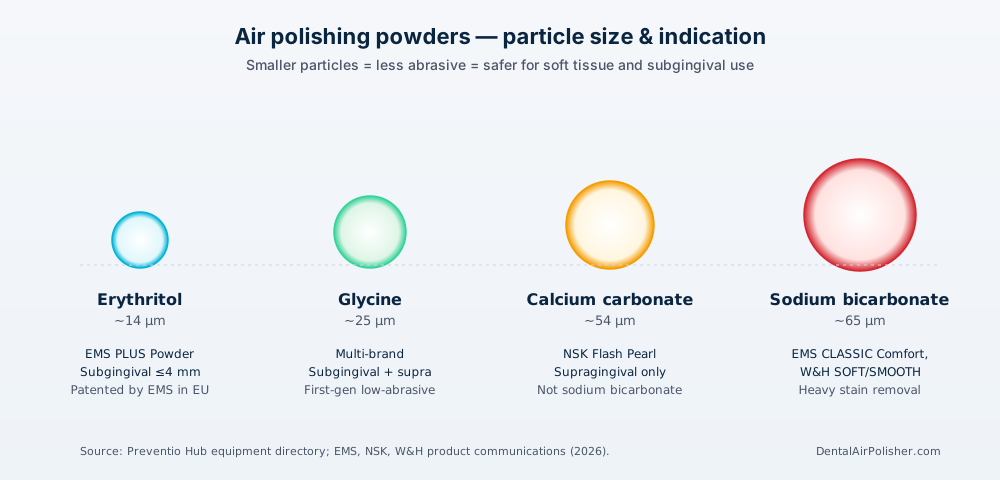
- Erythritol — smallest particle size (~14 µm), lowest abrasion, very low risk to enamel and root surfaces, the powder used in Guided Biofilm Therapy. EMS owns the European patent — only EMS devices in the EU are validated for it.
- Glycine — particle size ~25 µm, low abrasion, clinically established since early 2000s, validated for supragingival and (with the right nozzle) subgingival use. Available across all major manufacturers — EMS, NSK, Woodpecker, Acteon, Mectron.
- Sodium bicarbonate — traditional higher-abrasion powder. Stain removal only, supragingival, enamel.
Head-to-head: erythritol vs glycine
| Property | Erythritol | Glycine |
|---|---|---|
| Chemical class | Sugar alcohol (polyol) | Amino acid |
| Typical particle size | ~14 µm | ~25 µm |
| Abrasion on enamel | Very low | Low |
| Abrasion on dentin / root | Very low | Low |
| Soft tissue tolerance | Excellent | Excellent |
| Supragingival biofilm | Validated | Validated |
| Subgingival use | Validated with Perioflow nozzle (EMS) | Validated with manufacturer-specific subgingival nozzles |
| Implant surface | Validated | Validated |
| Pediatric / orthodontic use | Suitable | Suitable |
| Sweetness / taste | Lightly sweet, well-tolerated | Mild, neutral |
| EU patent status | EMS holds EU patent | Generic — multiple suppliers |
| Available across brands | EMS only (EU) | Yes — EMS, NSK, Woodpecker, Acteon, Mectron, more |
| Cost per kilo | Premium | Significantly lower |
| Used in formal protocol | Guided Biofilm Therapy (EMS / SDA) | Used across NSK M.I.T., Woodpecker ABC, custom workflows |
Why particle size matters
Air polishing works by directing a fine stream of powder, water and compressed air at the tooth surface. The powder particles dislodge biofilm and stains; the water cools and rinses. Smaller particles penetrate biofilm structures more effectively, transfer less kinetic energy into the surface they hit (lower abrasion), and produce a smoother feel for the patient.
Erythritol's ~14 µm particles are noticeably smaller than glycine's ~25 µm. The clinical difference is most visible in three places:
- Root surface preservation — particularly relevant in supportive periodontal therapy on exposed cementum/dentin.
- Patient comfort — less impact on the surface, less perceived "spray harshness".
- Implant surface safety — both powders are validated, but erythritol's smaller particle is gentler on textured implant surfaces.
For most routine prophylaxis on enamel, the abrasion difference is subtle and clinically equivalent. The advantage compounds in periodontal and peri-implant maintenance.
The EMS European patent — what it means in practice
EMS holds a European patent on erythritol-based air polishing powder. This is the single biggest reason the powder market is fragmented:
- In the EU, only EMS-branded erythritol powder (typically the EMS AIRFLOW PLUS powder) is validated and sold for dental air polishing.
- Non-EMS manufacturers (Woodpecker, NSK, Acteon, Mectron) cannot validate their devices for erythritol in Europe, so they don't ship the powder.
- "Woodpecker Super Powder" sold in Europe is a glycine formulation, despite the marketing-friendly name.
- Using third-party erythritol on non-EMS hardware is unsupported — it can void warranty and damage the powder chamber.
Outside Europe the situation varies by country. Some markets have patent expirations or different IP regimes. If you're in a non-EU market and erythritol is being offered for non-EMS equipment, confirm directly with the manufacturer that the specific SKU is validated for that powder.
When erythritol is the right choice
- You're committing to Guided Biofilm Therapy as your structured hygiene model.
- You want formal GBT-certified practice status (requires EMS equipment + SDA training).
- You have a periodontal-heavy case mix where subgingival biofilm management on root surfaces is routine, and the lowest-abrasion option matters clinically and commercially.
- You're equipping a premium hygiene operatory and the marginal cost of erythritol is justified by your patient base.
- You want the cleanest patient comfort story — erythritol is consistently the easiest for sensitive patients.
When glycine is the right choice
- You want a cost-effective low-abrasion powder for routine prophylaxis and biofilm management.
- You're cross-shopping non-EMS brands (Woodpecker, NSK, Acteon, Mectron) — glycine works on all of them.
- You handle subgingival cases with a validated subgingival nozzle and powder (NSK Perio Mate Powder, equivalent on other brands).
- You're in a price-conscious market segment where erythritol's marginal clinical advantage doesn't justify the cost gap.
- You're not pursuing formal GBT certification.
What about sodium bicarbonate?
The traditional powder. Higher abrasion (typical particle size 65-250 µm). Used for supragingival stain removal — coffee, tea, tobacco, chlorhexidine staining. Not suitable for routine biofilm management on root surfaces. Not used subgingivally — too abrasive, risk of dentinal hypersensitivity and root damage. Most modern hygiene workflows reserve sodium bicarbonate for the specific stain-removal indication and use glycine or erythritol for biofilm.
If your case mix is heavily stain-removal focused (e.g. cosmetic-led practice, heavy tea/coffee patient base) and biofilm management is secondary, sodium bicarbonate retains a role. Otherwise treat it as a niche tool rather than the everyday powder.
Putting it together — which powder, which device
| Your priority | Powder | Device family |
|---|---|---|
| Formal GBT certification | Erythritol (PLUS) | EMS Airflow PM or GBT Machine |
| Premium prophylaxis, EMS ecosystem | Erythritol + glycine | EMS Airflow PM / GBT Machine |
| NSK M.I.T. protocol | Glycine + bicarbonate | NSK Varios Combi Pro2 + Prophy-Mate neo |
| Cost-competitive combined unit | Glycine + bicarbonate | Woodpecker PT-E / NSK Combi Pro2 |
| Already own a scaler, add polishing | Glycine + bicarbonate | NSK Prophy-Mate neo / Acteon Air-N-Go / Woodpecker AP-H |
| Subgingival heavy case mix | Erythritol or glycine with validated subgingival nozzle | EMS (Perioflow), NSK Perio-Mate |
| Stain removal specialist | Sodium bicarbonate | Any modern polisher with bicarbonate chamber |
Powder cost — what to expect
Cost order, lowest to highest per kilo: sodium bicarbonate < glycine << erythritol. The gap between glycine and erythritol is substantial — typically several multiples — and the gap is widened by the EMS patent restricting supply. Annual consumable cost is a real factor in total cost of ownership. Multiply your projected annual powder usage by the per-kilo price for each powder and you'll see whether the clinical advantage of erythritol justifies the cost in your specific clinic context.
The math typically favours erythritol in periodontal-heavy clinics with strong margins, and glycine in routine-prophylaxis clinics where powder is consumed by volume.
What to ask your distributor
- Which exact powders are validated on the device you're quoting (be specific — PLUS, COMFORT, CLASSIC, Super Powder, FLASH pearl, SOFT pearl, Perio Mate Powder).
- Local stock of each powder vs imported with lead time.
- Per-kilo / per-bottle cost for each powder.
- Subgingival nozzle compatibility with each powder.
- Warranty impact of using third-party powders (don't try this).
- Storage and shelf life requirements.
Related guides
- Guided Biofilm Therapy — the EMS protocol that runs on erythritol.
- NSK M.I.T. Protocol — the NSK periodontal pathway with glycine + bicarbonate.
- Woodpecker ABC Protocol — glycine-based three-stage workflow.
- How to choose a dental air polisher — the 7 questions.
- EMS Airflow vs Woodpecker PT-E — the powder advantage in context.